
If You Could Only Select ONE lens...what would It be??

I made this portrait of Sparky the other day using the Sony a7R II and the 55 f1.8 Zeiss lens. This was made at f1.8 and if you look closely at the shape of the out of focus elements (or "bokeh") in the background you'll see the distinctive look of Zeiss lenses. I happen to be in love with that effect but also love that with this focal length -- the "normal" lens on a full frame sensor -- their is a hint of the background. Were I to shoot this on an 85mm focal length the background elements would render differently.
There are very few “musts” in this world but for me the must have lens is the 55mm (50mm) or the “normal” lens for my full frame Sony a7R II or a7S II cameras.
For many reasons — which include size, weight, speed and perspective — all make this the one lens I would want if I had to choose just one.
(If you are shooting with a camera that is an APS-C sized sensor, then I would revise that to be the 35mm focal length —which loosely translates to the “normal” focal length on that size sensor. For the purposes of this note when I refer to the 50, I’m referring to the normal lens).
This is a deceptively simple lens — often called the “nifty fifty” because it does so much and can be really inexpensive (the 50mm f1.8 for Sony, Canon and Nikon all have offerings that are in what I would classify as the very inexpensive range (around $300).
Back in the 70s and 80s the 50mm lens was the "kit lens" that has been replaced by the ubiquitous kit zoom lens (16-50, 18-55, etc.) over the past 15 years or so.
The Sony 55 f1.8 is a bit pricer because it is more robust and is badged with the Zeiss brand making it one of the most unique lenses that I have used in this range. Zeiss out of focus elements have a certain look that I’ve never seen in any other brand. I have a 50mm f1.4 manual focus lens in Canon EF mount that I now use on my Sony cameras with a Fotodiox adaptor and again those out of focus elements are a thing of beauty to me with these particular Zeiss branded lenses).
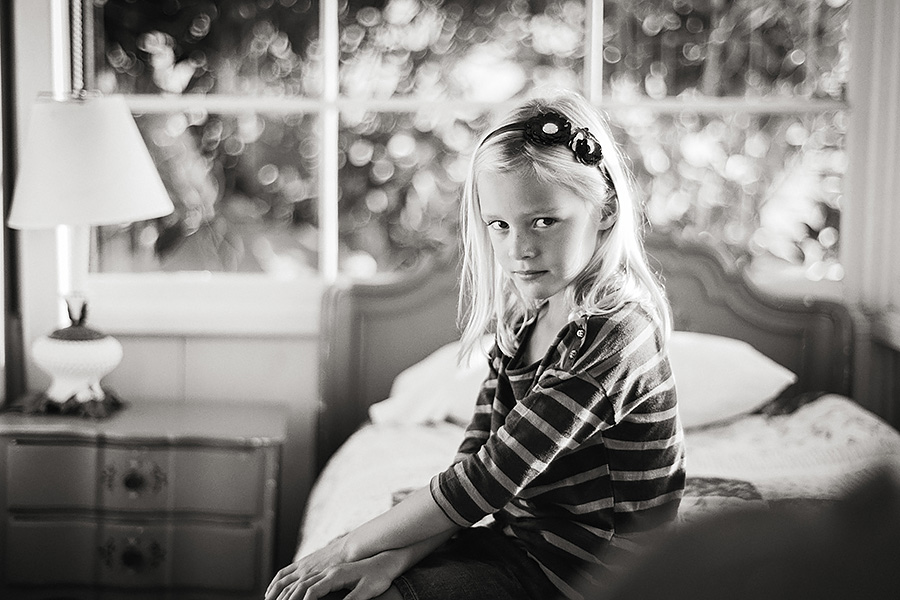
This portrait of Jorryn, made with a 50mm f1.4 Zeiss lens was shot at f2 and again shows the signature highlights or bokeh that I have come to love with the Zeiss branded lenses. And, because it's a 50mm focal length there's enough detail of the scene (here showing one of the historic Crystal Cove cottages where the family was vacationing).
More expensive and faster aperture lenses like the 50mm f1.2L from Canon push the price up but do offer a faster aperture and thus ability to keep ISO down and also get a more out of focus look at maximum aperture.
This lens is also usually quite lightweight (unless you opt for the f1.2L in Canon — but the 1.8 versions of all the big three brands are quite lightweight). The 55 1.8 Sony is heavier but is still significantly smaller and lighter than the 50 1.2L in Canon.
Having that fast aperture lens gives you a distinctive look — there’s even a dramatic difference from f2.8 to f1.8. The other day I was testing a new 50mm lens with a friend and we were amazed at just how much difference in sharpness and definition in the background elements there were from f4 to f1.5 (the maximum aperture for this lens— the Voightlander Nokton 50mm f1.5. This is a Leica M mount lens that can be adapted for Sony E mount cameras using, in his case, the Voightlander Close Focus adaptor).
But the real beauty in the focal length is perspective. All the techie things are cool but what the lens really gives you is the look. The 50/55 just gives you a perspective, especially when coupled with the large maximum aperture that can really draw in a viewer by how you place your subject in the frame and what you decide to include.
Stand back quite far from your subjects and they become an element in the landscape but aren’t so small that you can’t see them (as might be the case with wide angle lenses).
Move in close and you can get some interesting portraits (especially for more environmental type portraits) — interesting because they still allow for a bit of context in the background. Even at a large aperture there can often be enough tell-tale signs of where and what the background is but, because of the large aperture, doesn’t distract or detract from the subjects.
If you photograph the same scene with a short telephoto lens like the 85mm on a full frame sensor camera, those background elements are further softened and any context is taken away because of the narrower angle of view.
The 50 was a lens that I originally didn’t use. I thought it too ordinary. But when you look at all the great work shot over the decades with that normal lens by greats such as Henri Cartier-Bresson among others, you begin to respect the power of this focal length.
When coupled with vision and skill and a commitment to make that lens work, the images that you can produce from it are magical.
So how about you? What lens would be YOUR one lens?
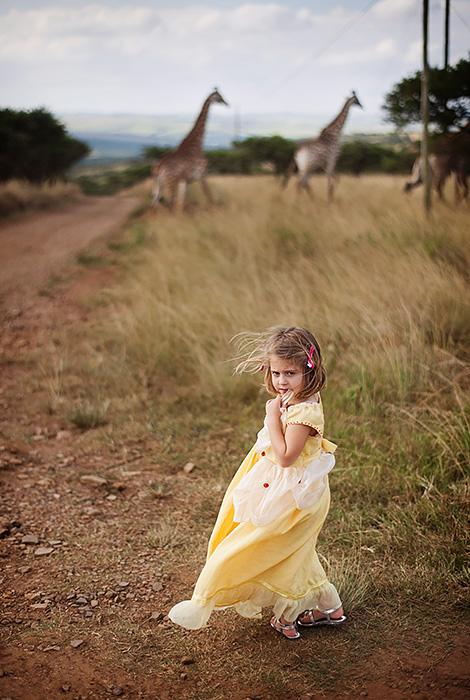
Still one of my favorite portraits of my daughter Kate made to date (even though she is WAY beyond the "Princess stage". Shot in Africa (while visiting family) we were at a game reserve and those are giraffes in the distance. Shot with the Zeiss 50mm f1.4 again at f2 there's the right amount of sharpness and out of focus elements to give the photograph an interesting look. I call this one "Beauty and the Beasts" and it's even more special because her Granny Moira handmade the Belle dress for her.
Think Tank Releases a New Roller & Adds to Their Retrospective Line of Bags
Our friends at Think Tank Photo just released the largest photo lighting rolling bag ever and have added a new size and color to their popular Retrospective shoulder bag series.
The Production Manager 50 is a monster, designed to hold C-stands, multiple flash heads, power packs, monoblocks, softboxes, and light-stands. What it used to take two people to transport, you can now do by yourself.
And, they’ve added a new color—Sandstone—to their Retrospective line, and the new Retrospective 6, which holds Mirrorless systems or a gripped DSLR. Don’t forget, that by using these web links to order you will receive free gear and free shipping.
You can order the Production Manager 50 here:
Production Manager 50
https://www.thinktankphoto.com/products/production-manager-50?rfsn=140905.1cb641
You can order the Retrospective 6 Bag Here:
Retrospective 6 Shoulder Bag
https://www.thinktankphoto.com/products/retrospective-6?variant=15022588291&rfsn=140905.1cb641
(please note that these are affiliate links. They add nothing to your cost and by using these web links you receive free gear and free shipping)
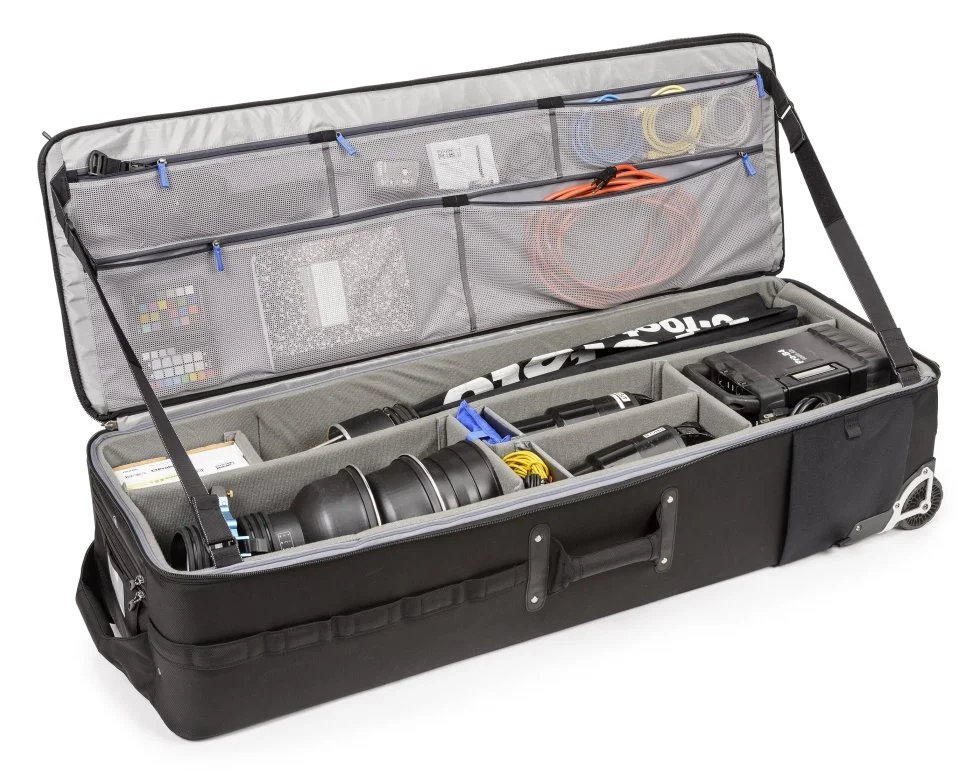
Think Tank just announced their larger roller case to date which will allow for heavy duty flash units, and even C stands. It's called the Production Manager 50.

The Think Tank Photo Retrospective Line of Bags now adds Sandstone to their color palette.
Could the Sony a6300 change the way you think about an APS-C sensor camera??

The new Sony a6300 might be the camera that changes the way you think about small form-factor, APS-C sensor cameras. I know it has me falling back in love again with the APS-C format.
Follow me on Instragram: https://www.instagram.com/paulgero/
I’ll admit it, I’ve always been a bit of a “full frame” camera snob (24 x 36 mm sized sensor). I learned on that format (35mm film) and shot for a LONG time with those focal lengths from prime lenses burned firmly into my brain and my muscle memory. Change can be difficult (but not impossible).
When I first got into digital capture in the late 90s, those cameras had something like a 2.5X crop (if I remember correctly) and it was merely a black line placed within the actual optical viewfinder.
Not terribly precise and that crop factor really altered how lenses worked on your cameras!
My first assignment with a digital camera was photographing a U2 concert in 1997 and using the 70-200 lens it was a wee bit tight, but it worked.
But my appreciation for cropped sensor and especially APS-C began to change when I got into mirrorless cameras in 2012 (what you see is what you get with the built in EVF) and when I switched to Sony with the a6000 the camera became my “go-to” camera when I needed a bit of reach and if I needed AF focus performance (plus speed). At 11 fps it was a scary little camera beast when you considered how little it cost and how tiny it was.
So when Sony announced the a6300 earlier this year (Feb. 3, 2016) I let out an audible yalp (the release of the 3 new lenses didn’t hurt either) but I had been waiting for this little camera for quite a while. It was worth the wait.
Recently I got 6300 camera and I have to tell you, it might very well be the best camera I’ve ever used when you consider size, features and price.
The size is small — under 1 lb. (14.25 oz with a card and a battery), the features include 11 frame per second with over 400 Phase Detect AF sensors, 8 fps in continuous Live View (making the experience more like an optical viewfinder), Face Detect, Eye AF in AF-C mode, Silent Shooting mode (and I mean SILENT), an electronic level, 4K video with no pixel binning in Super 35m size video, Slog2, Slog3 and Gamma Assist and comes in at a price of just under $1k.
It is, I firmly believe, the kind of camera that could be at the core of a six figure wedding and portrait (and maybe even a video business?), it’s simply that good of a camera.
And as much as I love my a7R II cameras and the a7S II cameras (which are full frame) that a6300 has made me SERIOUSLY rethink some of the lens choices I might be making in the coming year.
I’ve always felt that one should get the full frame FE mount lenses for Sony because they’ll work on both the full frame cameras and the APS-C sensor cameras but now with this camera I am totally thinking I might be investing in lenses that are specifically for E mount or APS-C sensors (and the added bonus with Sony is that they can STILL be used on full frame cameras like the a7R II in cropped, APS-C mode. How cool is that?)
One of the reasons is that the size of the camera makes taking it out and about a serious joy. It’s a fraction of the weight of a full sized or even cropped sensor DSLR and depending on the lenses you select, they can be smaller and lighter too. It’s a camera that won’t tear down your body and when you consider the longevity of a career in photography, that is an important consideration.
I had the chance to use two of the a6300 cameras recently when shooting an assignment for Hail Varsity magazine on the University of Nebraska women’s beach volleyball team playing in Southern California and the camera performed like a camera six times the size and six times the cost. It was that good.
(I’ll have a separate report on that shoot very soon — the magazine is finalizing the edit on the photos and I can’t wait to share it!)
If you stick with the Sony glass you have the ability to have a small package in camera and lenses: the 10-18, the 16-70 and the 70-200 f4 G OSS lenses are all relatively small, and allow you to cover a range basically from 15mm to 300mm with 3 lenses.
And there are two Sigma (yes Sigma) zooms that are made specifically for APS-C sensors and when you couple them with the soon-to-be-released Sigma adapter to mount their EF mount lenses on Sony E mount (MC-11, for about $250, coming in April) you’ve got an incredible range of optics and speed options — options that were unheard of or unimagined even as little as two years ago.
The two lenses that I am thinking of specifically for the a6300 are the 18-35 f1.8 zoom and the 50-100 f1.8 zoom. When you consider the crop, they are basically a 27-52.5 f1.8 and a 75-150 f1.8 lens. Where were these lenses back in the day when we didn’t even have decent high ISO sensors? I sure could have used the f1.8 aperture. Plus Sigma just announced a 30 f1.4 lens for $339 which should be an awfully great “normal” focal length (like a 50mm focal length on a full frame camera). For weddings, portraits and for videographers those three lenses alone could be the making of a complete kit and then supplemented
with perhaps a 70-200 f4 FE G OSS or the soon-to-be-released 70-200 f2.8 G Master with the 1.4X and 2X tele extenders. If you need anything wider, then the 10-18 f4 Sony lens with OSS would complete the set.
The cost of the kit with the Sony lenses would be:
a6300 $998
a6300 $998
Sony 10-18 f4 OSS lens$848
Sony 16-70 f4 Zeiss$998
Sony 70-200 f4G OSS $1499
Total: $5341
The cost of the kit with the fast Sigma lenses and adapters would be:
a6300 $998
a6300 $998
Sigma 18-35 f1.8 $799 (Canon EF mount)
Sigma 50-100 f1.8 $1099 (Canon EF mount)
Sigma 30mm f1.4 $339 (Sony E mount)
Sigma MC-11 adapter $249 (Canon EF to Sony E mount — Sigma lenses only)
Sigma MC-11 adapter $249 (Canon EF to Sony E mount — Sigma lenses only)
Total: $4731
For that kit built around the Sigma lenses, you might add the 10-18 and the 70-200 f4 G OSS (or even the soon-to-be-released 70-200 f2.8 G Master lens).
Sony 70-200 f4 G OSS $1499
Sony 70-200 f2.8 G Master ($?)
Sony 10-18 f4 OSS $848
Sony 16-70 f4 Zeiss $998
Talk about some amazing options for photographers with gear that doesn’t break the bank or the back.
Sony continues to raise the bar and change the game and I only expect that to continue.
Follow me on Instragram: https://www.instagram.com/paulgero/
The Sony a6300 arrives today and here's a quick unboxing video!
Today the Sony a6300 arrived and this little unboxing video shows what is included with the camera and kit lens package. Hard to believe a 4K camera coming in at just under $1k (for video)....and for still shooters it's got 8 fps continuous live view and Silent Shooting!! Pretty darn amazing little camera.
Sony's a6300 and new G-Master Lenses and what they mean for wedding & portrait photographers!
Sony created quite a stir in the photographic world last week when they announced the highly anticipated a6300 which will supersede their wildly successful a6000 camera.
This will be a 24 megapixel, aps-c sized sensor that fires 11 fps and 8 fps in continuous live view.
Not only is it a potent still camera, this camera has 4k video as well as the hotshoe/multi-interface shoe that accepts the sony XLR K2M microphone adaptor (as well as a microphone in port). This camera will sell for just under $1000 US.
In addition to the new camera, Sony released three G-Master lenses: a 24-70 f2.8, 70-200 f2.8 and an 85 1.4 lens. These lenses are designed from the ground up and are built for the future of digital imaging.
These lenses are three of the most popular lenses for a variety of photographic genres, including wedding, portrait, fashion and journalism.